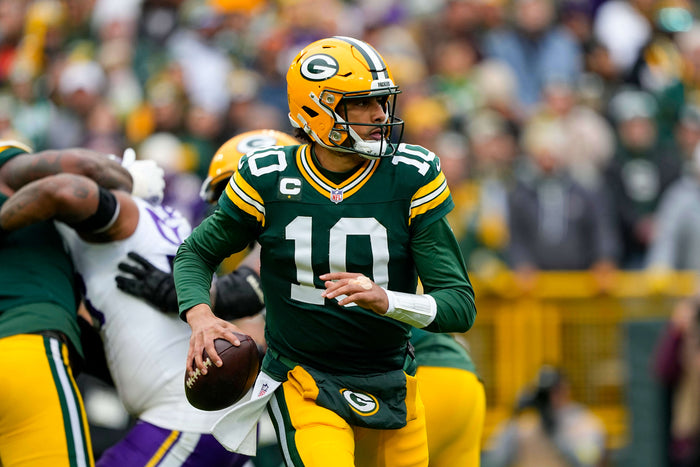
Four Things the Green Bay Packers Can Do to Cover for Their Struggling Offensive Line

The Green Bay Packers offensive line got off to a terrible start this season. The team Vikings blitzed more than 70 percent of the time, and they got consistent pressure on Jordan Love. The poor line play led to turnovers and the team’s collapse in their 39-22 loss. The Packers weren’t ready for their Week 1 matchup despite having the entire offseason to prepare. While some of the problems will be tough to fix, here are four things the Packers can do to cover for their struggling offensive line in Week 2 and beyond.
Four Things the Packers Can Do to Cover for the Offensive Line, Number One: Change Starters
The Packers started Donovan Jennings and Jacob Monk at guard last Sunday. To be kind, the results were not good. Jennings had never started an NFL game before, and Monk had one start in a game where the team was resting as many preferred starters as possible. When you also consider that Zach Bako-Bewele was returning from a serious injury and neither Sean Rhyan nor Jordan Morgan had made more than a handful of starts at their respective positions, this was a recipe for disaster.
The Packers expect starting left guard Aaron Banks to be a game-time decision again in Week 2. Even if Banks cannot play, the Packers need to consider starting Anthony Belton and/or Jager Burton over Monk and Jennings. The sooner they determine who the best available five players are, the sooner they can begin to develop some chemistry along this offensive line. But wasn’t that what training camp and preseason were supposed to be for?
Number Two: Go to More Quick Release Passes
One adjustment the Packers never made against the Vikings was to change their offensive approach and emphasize shorter, quick release passes that will limit the effectiveness of blitzes and stunts. We did not see enough screen passes to running backs, wide receivers or tight ends.
When you have a player who excels at running after the catch like Tucker Kraft, targeting him on quick release passes and screens can create either splash plays or just consistent gains on offense that we just didn’t see against Minnesota.
Ultimately, when you’re hamstrung by a struggling offensive line, you have to adjust your play calling. Let the defense be aggressive and make that aggression work against them whenever possible.
Four Things the Packers Can Do to Cover for the Offensive Line, Number Three: Run More RPOs
Another option which overlaps with the quick release passes but isn’t identical to them is to run more run/pass options or RPOs.
This plays well into some of the offense’s strengths including Love’s decision making and the ability of players like Kraft, Matthew Golden, Christian Watson, and Jayden Reed, to get open quickly off the snap of the ball.
If also uses the defense’s aggressive play against it. If the defense has eight men in the box, you call a pass. If they drop back into a deep zone, you can call a running play and hope the offensive line can get the job done blocking for it.
Number Four: Use More Two Tight End Formations
The Packers have options to improve their blocking by using more two-tight end formations. Kraft gives the team a good blocking tight end, but ideally you don’t want to keep him in as a blocker too often if you’re throwing the football because he’s such a good receiver.
But the Packers also have Mark Redman as a blocking tight end. They could easily keep him in to block on both running and passing plays. Last week, Redman played 21 snaps or 31 percent of the Packers offensive snaps. If the pass protection continues to struggle, he should be on the field more often.
The Packers could also utilize an extra offensive lineman as a tight end to improve their pass protection. Last year, they used Darian Kennard in that role, but they have other players who can do that this season. In fact, that role may make more sense for players like Jennings and Monk rather having then start.
Jonnu Smith could also be utilized as a short receiver on quick release passes from a two-tight end set. While blocking is not his strong suit, even having him chip a potential pass rusher before dropping into the flat could be a way to help the offensive line.
Matt LaFleur has options here, but he must make adjustments based on what he saw in Week 1. They say that doing the same thing over and over again and expecting different results is the definition of insanity. Now LaFleur has to prove he’s not insane and address these issues in Week 2.
Follow Gil Martin on Twitter @GilPackers
Click here for more great Packers coverage
Check out our YouTube channel here
Keep reading
SACKED: Offensive Line Overwhelmed in the Packers 30-10 Loss to the Minnesota Vikings in Week 10
Five Former Green Bay Packers Players You May Not Know Also Played for the Vikings